
Early fire detection and thermal inspection
TempCheck uses radiometric thermal cameras to find heat where it shouldn’t be: hotspots in waste and bulk materials before they become fires, and thermal faults in products such as adhesive beads and batteries. Non-contact, continuous and recorded.
Hotspots and rate of rise; bead and battery heat
Waste, bulk materials, adhesive beads, batteries
Continuous monitoring
Fixed thermal cameras with alarm integration
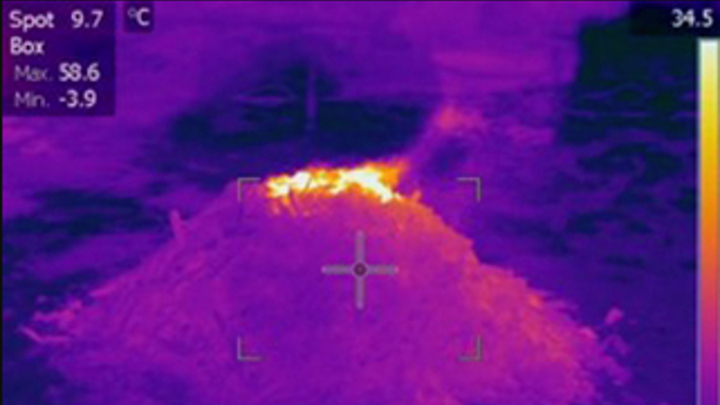
Heat is the earliest warning, if you can see it
A lithium battery smouldering in a waste bunker, a dust build-up on a hot conveyor or a self-heating stockpile gives off heat long before smoke or flame. In production, a broken adhesive bead or an overheating battery cell shows up thermally before it fails in service.
TempCheck watches continuously and alarms on abnormal temperature, giving people time to act before damage is done.
What TempCheck detects
Two uses of the same thermal capability.
Hotspots in waste and bulk storage
Rising surface temperatures in bunkers, tipping halls and stockpiles, before flame appears.
Heat build-up on lines and conveyors
Dust, friction and overheating bearings on process lines and conveyors.
Hot loads at reception
Battery-related hot loads found as waste is received.
Adhesive and sealant beads
Bead continuity checked thermally after application, where it can’t be seen once parts are joined.
Batteries and electronics
Abnormal heat signatures in cells, modules and electronic assemblies.
How TempCheck reaches a result
Every Bytronic system follows the same five stages. This is what each one means for TempCheck.


Sense
Radiometric thermal cameras measure dust surface temperature across the scene – day and night.
Understand
Software separates real hotspots or faults from normal process heat.
Decide
Temperature and rate of rise is compared with limits for each zone or part.
Act
Alarms to operators, suppression and plant systems, or rejects triggered at the station.
Prove
Thermal events by zone, time and load show where risk concentrates.
Can you rely on the result?
Every thermal detection system carries two conflicting operational risks: raising a false alarm or missing a real hotspot. A vision platform is only viable if your technical team knows its measured error rate and the validation limits applied to each check. Three things keep both risks under control:
Temperature and rate of rise are compared with limits set for each zone or part, so normal process heat isn’t treated as a fault.
Configured to your site and tested in a live trial, not a demonstration. You see performance against an agreed baseline, including false alarms and missed hotspots.
Limits and settings for each zone or part do not change without approval. Any change is controlled, re-tested and recorded.
The system you validated is the system that runs.
One system: hardware, software, integration and data
TempCheck is delivered as a complete system, designed for your line, installed and
commissioned by Bytronic engineers, and supported through its working life.
Hardware
Radiometric thermal cameras, including Termisk Systemteknik fire prevention systems for waste and energy from waste sites, with mounting for harsh environments.
Software
Zone based temperature and rate of rise detection; inspection logic for product checks.
Integration
Alarms integrated with suppression, PLC and plant systems; reject logic for product inspection.
Data and evidence
A thermal record of every event and result, for incident review, insurers and quality records.
Thermal inspection across industries
Fire risk where material is stored and handled; thermal checks where products are built.
Bulk waste handling
Waste reception, bunkers, storage and processing, and bulk materials such as biomass.
Specification and deployment
Each system is designed for the customer’s line. Typical parameters:
| Imaging | Radiometric thermal cameras |
|---|---|
| Detection | Temperature thresholds and rate of rise, per zone |
| Environment | Works in darkness and through dust |
| Alarms | Local and remote; interfaces to suppression and plant control |
| Fire-prevention systems | Termisk Systemteknik, through Bytronic’s partnership |
| Detection range and resolution | Specific to customer requirements and application |
| Records | Thermal image and data for every event |
A candid view before you invest
Best suited to
- Hotspot detection in waste, recycling and bulk handling
- Heat build-up on dusty lines and conveyors
- Thermal checks on adhesive beads and batteries
Another solution may fit better for
- Cooking temperature of food products: TempComply
- Glue on cartons and cases: HotSpot
- Certified fire alarm systems, which TempCheck complements rather than replaces
- Fire deep inside a pile with no surface signature yet, which needs probes or gas monitoring
Not sure which applies? Talk to an engineer and we’ll map your line. Something not covered here? Bring us the problem.
Thermal detection in practice
Fire prevention at a major waste recycling site
Battery fires in incoming waste put the site at risk. Thermal cameras monitor reception and storage continuously. Hotspots found and dealt with before they become fires.
Early fire detection at a global cereal producer
Dust on high-speed lines created a risk of heat build-up. Thermal cameras monitor the lines continuously. Heat build-up flagged before it becomes a fire.
Adhesive bead inspection
A bead can’t be seen once parts are joined. Thermal imaging shows bead continuity after application. Broken beads caught at the station.
TempCheck works with
We choose on fit, not brand: our own technology where it gives the best outcome, partner technology where it is better, and combinations where one technology is not enough.
Frequently asked questions
What is TempCheck?
TempCheck is a thermal inspection and early fire detection solution from Bytronic Vision Intelligence. It uses radiometric thermal cameras, including Temerisk Systemteknik fire-prevention systems on waste sites, with Bytronic software that alarms on abnormal temperature and rate of rise. It finds hotspots iin waste bunkers, bulk storage, conveyors and dusty production lines before they become fires, and checks adhesive beads and batteries for thermal faults.
What is automatic fire detection?
Automatic fire detection raises an alarm without a person noticing first. Thermal early fire detection goes further, alarming on abnormal heat before smoke or flame.
What are thermal cameras used for in industry?
Measuring temperature without contact: early fire detection, checking adhesive beads and seals, and finding abnormal heat in batteries and electrical equipment.
Can TempCheck replace our fire alarm system?
No. TempCheck adds an earlier warning mechanism to a layered fire strategy and complements certified fire alarm and suppression systems.
Does thermal detection work through dust?
Yes. Thermal cameras measure infrared radiation, so they work in darkness and see through dust better than visible cameras.
Why are battery fires rising in waste?
More products now contain lithium-ion batteries, and many end up in general waste. When they are crushed during collection and handling they can short-circuit and ignite the material around them.
Prove it on your line before you commit capital
No off-the-shelf system fits a real production line perfectly, so we prove performance first, with a fully managed trial on your line.
Scope the problem
We map the exact failure, its cost and where it happens on your line.
Run a live trial
We design, install and run the inspection on a designated line, configured to your products.
Show the business case
You get real performance data against an agreed baseline and projected payback.
Install and support
We integrate, commission, train your team and support the system through its life.
Recognised by industry


Find the heat before the fire
Tell us where your risk is. We’ll demonstrate how thermal detection buys you the most time.